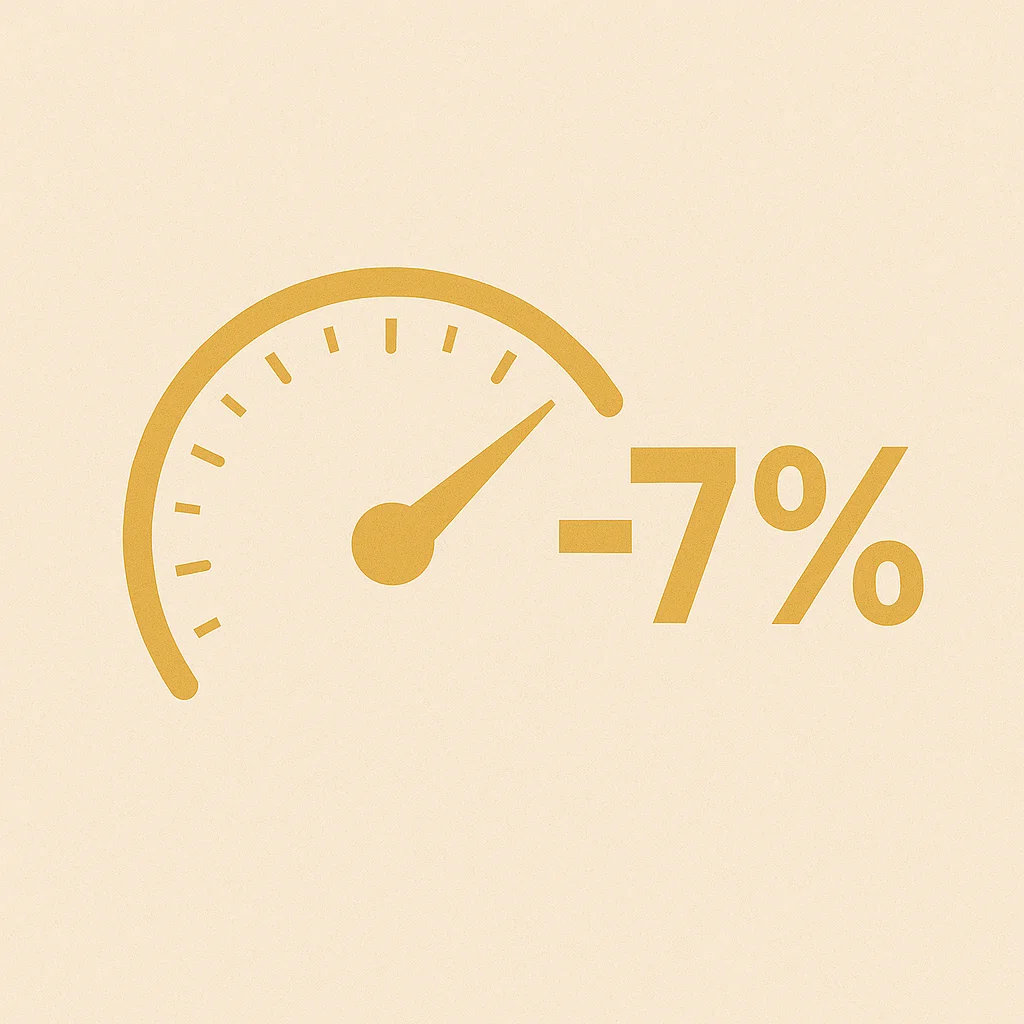
Studies by Google and Akamai reveal a harsh truth for e-commerce: a page load delay of just 1 second reduces conversion by 7%.
One more second—and you lose 16% of mobile visitors. These are not abstract figures for giants like Amazon. This is real money your business is losing every single day.
Website loading speed is no longer a technical whim, but one of the key business metrics that directly affects sales, Google rankings, and customer loyalty.
In this article, without fluff or complex professional jargon, we explain exactly where you are losing money due to a slow website and how systematic website speed optimization can become your main competitive advantage.
How website speed directly affects your bank account
Many entrepreneurs perceive speed as something abstract. But its impact can be easily measured through three key business metrics. 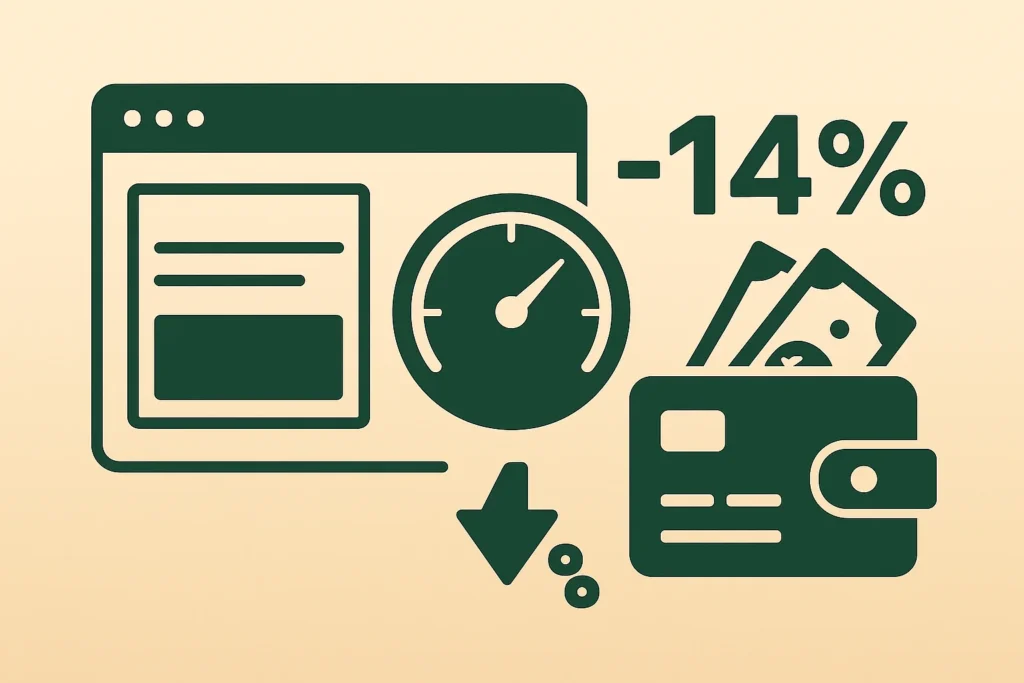
1. Conversion (that is, your direct sales)
This is the simplest and most ruthless connection: the slower the website loads, the fewer people buy. Every second of waiting increases the bounce rate. The customer, especially on mobile, simply closes the tab and goes to a competitor without waiting for your products to load.
Let’s translate this into money. Imagine your store has a turnover of 200,000 UAH per month. Your website loads in 4 seconds instead of the recommended 2. This 2-second difference, according to Google, can cost you up to 14% of conversion.
Let’s calculate it: 14% of 200,000 UAH is 28,000 UAH in direct monthly losses. Or 336,000 UAH per year. That’s the price of a good car, lost simply because your website is not fast enough.
2. SEO rankings (that is, customer acquisition cost)
Google loves fast websites and hates slow ones. In 2021, the search giant introduced Core Web Vitals—a set of metrics that became an important ranking factor.
What does this mean in simple terms?
Google evaluates three things: how fast the main content loads, how quickly the site responds to the user’s first interaction, and whether page elements shift during loading (which is extremely annoying when you try to click one thing and hit another).
How to check this?
The simplest tool is PageSpeed Insights from Google. It will show your website’s score and highlight the main issues.
Business impact! Poor Core Web Vitals scores = lower search rankings. This means you get less free organic traffic and are forced to spend more money on paid advertising to compensate.
3. Loyalty (that is, repeat sales)
A slow website is like a store with dirty display windows and a huge line at the entrance. Even if you have the best product, a negative first experience discourages users from coming back. Studies show that almost 80% of users will not return to a website if they are dissatisfied with its performance.
You pay to acquire a customer, they struggle through one purchase, but you lose the most valuable thing—all their future orders (LTV). A fast and convenient website, on the contrary, creates a positive experience and encourages users to return again and again.
The three main bottlenecks of your online store
Website speed optimization starts with diagnostics. Usually, slow website performance is the result of three common problems that can and should be fixed. 
1. Heavy and unoptimized images
This is reason number one. High-quality product photos are critical for sales, but when each image weighs 5–10 megabytes, a category page with 30 products turns into a gigabyte monster that loads forever, especially on mobile internet.
Solution — image optimization
This does not mean reducing quality. Modern tools compress photos without visible loss and convert them into fast formats (for example, WebP), reducing their size by 5–10 times.
2. Cheap and low-quality hosting
Hosting is the server where your website lives. Trying to save 100–200 UAH per month on hosting is one of the most expensive mistakes in e-commerce. Cheap shared hosting is like a communal apartment: you share resources (CPU power, memory) with dozens of other websites. If one neighbor starts consuming resources aggressively, your website slows down.
Solution
Investing in a high-quality VPS (virtual private server) or specialized e-commerce hosting. This gives you guaranteed resources and significantly improves server response time—one of Google’s key metrics.
3. Unoptimized code and plugin overload
Every additional plugin, banner, pop-up, or analytics script is an extra request that forces the user’s browser to do more work. Websites, especially on WordPress, often accumulate dozens of plugins, many of which are poorly written, conflict with each other, and create excessive load.
Solution
Regular technical audits, removal of unnecessary scripts and plugins, and most importantly—clean and optimized code written with speed in mind from the development stage.
How we achieve maximum speed: 4 key technologies
When we develop a website at Kliox, speed optimization is not an optional add-on, but part of our core engineering culture. We use a comprehensive approach to make your website fly. 
- Advanced image optimization. We automate compression and conversion of all images into the modern WebP format, ensuring maximum quality with minimal weight.
- Caching at all levels. Caching means the website stores ready-made parts of pages so they don’t have to be generated again for each visitor. We configure caching at both server and browser levels, dramatically speeding up repeat visits.
- CDN (Content Delivery Network) integration. A CDN is a global network of servers. When a customer visits your website, content (images, videos) is delivered from the geographically closest server rather than your main hosting in Ukraine. For stores operating internationally, this is a must-have technology.
- Clean code and request minimization. We write lightweight and efficient code, combine and compress script and style files, and configure lazy loading for non-critical elements. Our goal is to show the user the most important content as quickly as possible.
Kliox: speed as a development standard
For many studios, website speed optimization is an additional service offered only after problems arise. For us, it is an integral part of the development process at every stage, from design to launch.
We don’t just create a beautiful online store design. We build an efficient engineering product. We embed principles into the site architecture that ensure high PageSpeed Insights scores and an excellent user experience from day one. For our clients, a fast website is not an option—it’s the standard.
Conclusions: a fast website is not a luxury, but a necessity
Website loading speed is a direct investment in your profit. Every millisecond you cut from load time increases conversion, improves Google rankings, reduces customer acquisition costs, and increases loyalty. In modern e-commerce, a slow website is a business that consciously refuses money.
Want to know how much money you are losing due to a slow website?
Order a free express speed analysis of your website. We won’t just send you a PageSpeed Insights report. Our technical specialist will explain it in plain language, identify the main bottlenecks of your site, and show how fixing them can impact your sales.