Choosing a platform for an online store is like choosing a foundation for a house. It is a strategic decision that will affect launch speed, total cost of ownership, scalability, and even your future sales. Making a mistake at this stage can be very costly.
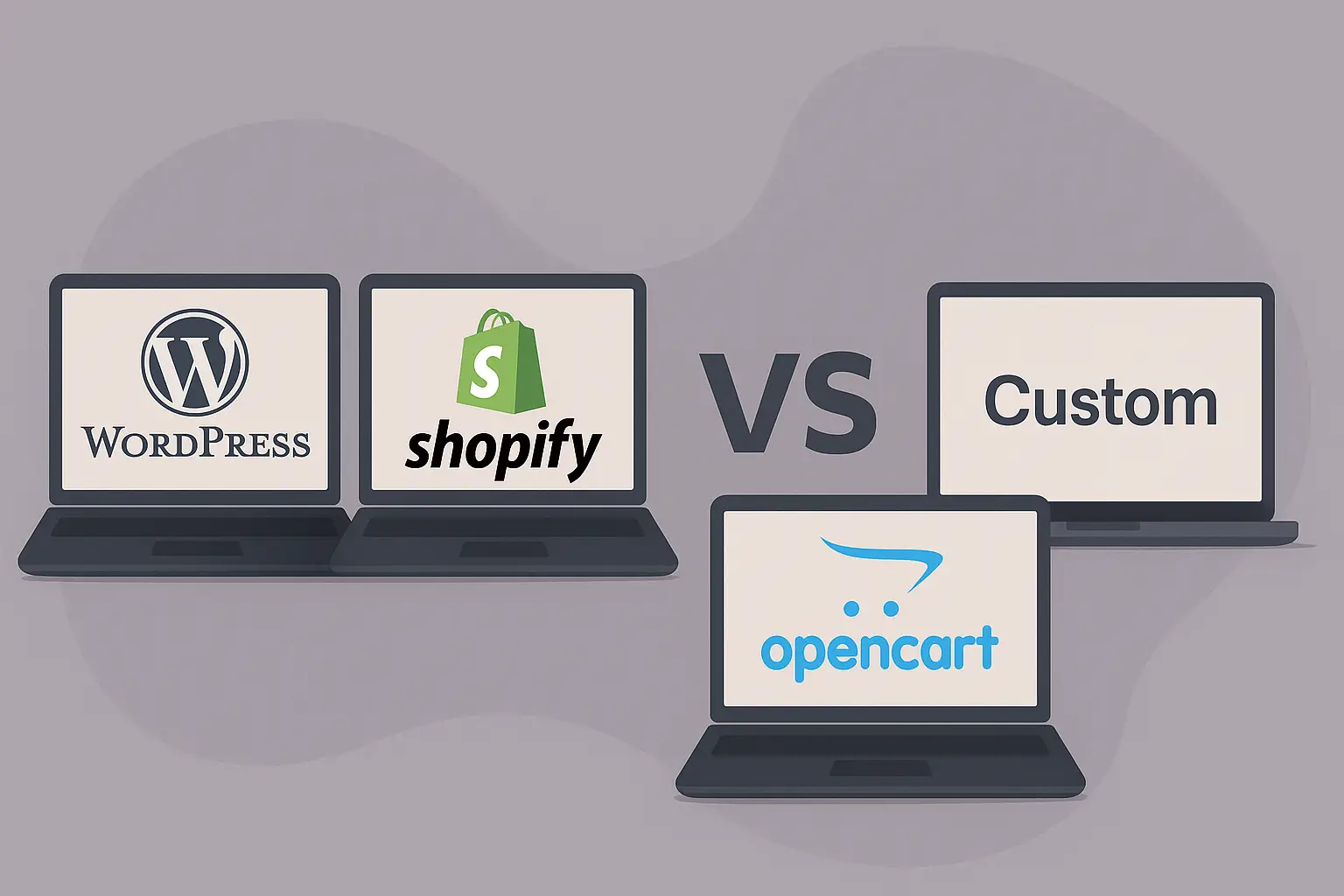
In this article, we provide an honest comparison of online store platforms and analyze four main approaches. We examine the pros and cons of each option to help you understand which CMS to choose for your specific business needs.
WordPress — full control and flexibility
Developing on WordPress with the WooCommerce plugin is the most popular solution worldwide. It is for those who value full freedom of action, flexible settings, and want to be the sole owner of their website.
- When to choose: You need a unique design, complex functionality (personal accounts, calculators), and full control over the site.
- Pros: Unlimited customization, full ownership without subscription fees, flexible SEO options.
- Cons: Requires quality technical support and updates.
OpenCart — reliability built for e-commerce
OpenCart is a specialized CMS developed exclusively for online retail. It is a reliable, time-tested ready-made platform ideal for stores with large inventories and a need for stable performance. 
- When to choose: You have a large product catalog (thousands of items) and need high speed and stability out of the box.
- Pros: High performance, easy management of large catalogs, many ready-made modules.
- Cons: Less flexible in design customization compared to WordPress.
Shopify — speed and simplicity
Shopify is an “all-in-one” platform that allows you to launch an online store in the shortest time. Essentially, it is a rented website from a reliable service that handles all technical concerns. 
- When to choose: You need to start selling as quickly as possible, plan to sell internationally, and do not want to handle technical issues.
- Shopify advantages: Simplicity and speed, maximum security, intuitive interface.
- Cons: Monthly subscription and fees, significant limitations in customization.
Custom — unlimited possibilities
Custom development is creating an online store from scratch. This option is for ambitious and large projects with unique business processes that do not fit standard solutions. 
- When justified: You need unique functionality (configurators, B2B portals), ERP integration, or a site capable of handling very high loads.
- Pros: Complete uniqueness, unlimited scalability, maximum security.
- Cons: High cost and long development time.
Platform comparison table
To make it easier to choose, we summarized the key characteristics of each platform in a single table.
| Criterion | WordPress | OpenCart | Shopify | Custom |
| Launch speed | Medium | Medium | Very high | Low |
| Development cost | Medium | Medium | Low | Very high |
| Flexibility | Very high | Medium | Low | Absolute |
| Ease of management | Medium | High | Very high | Depends |
| Total cost of ownership | Low | Low | High | Medium |
How we help with the choice
As you can see, there is no single answer to the question of which CMS to choose. The choice depends on dozens of factors: your budget, niche, and future plans.
That is why our first step is a deep business analysis. We do not start development on WordPress or any other platform until we are sure it is the best tool to solve your specific tasks. We act as objective consultants.
Conclusion: the right choice depends on your goals
There is no “best” platform—only the one that fits your business perfectly. The key is to make this strategic decision based on analysis, not emotions. A well-chosen technological foundation ensures successful scalability of your online store. 
Need help choosing?
If you are still unsure which path to take, let’s analyze your situation together. We will provide a free analysis of your business idea, discuss goals, and help select a platform that becomes a reliable foundation for online sales.