



We have formed a catalog structure with thoughtful filters, separate collections, and quick transition to purchase.
The Zentaro philosophy was conveyed through deep dark shades, contrasting typography, and an emphasis on fabric details.
We implemented management of products, sizes, balances, and orders with a flexible admin panel.
We created a logical catalog structure with multi-level filters by equipment type, power, brand, and purpose.
Visually, technical reliability and a professional approach were emphasized through a restrained color scheme and clear typography.
We implemented flexible management of products, characteristics, filters, and integration with CRM to automate applications.

We built a structure that logically leads from benefits to registration. We emphasized privacy, water safety, and the coach's individual approach.
Clients gained access to class history, subscription management, and online payments.
We automated the schedule, pool loading control, and communication with parents.
We start by defining the business model: what commission will be better (percentage or fixed), how subscriptions for sellers will work, what access levels will be required. We fix all the rules of interaction at the start.
We design two separate but related interfaces: logic for the Buyer (convenient search and reviews) and for the Seller (a clear dashboard for managing products and orders).
We are creating a core for managing market participants. This includes a system for registration, verification, uploading certificates, and setting up personal "storefronts" for each seller.
We integrate payment gateways that allow for automatic distribution of funds between the platform (commission) and the merchant. This eliminates manual payments and ensures transparency.
We are developing and testing a reputation management system. We are implementing mechanisms for evaluating sellers and buyers, as well as tools for quickly resolving disputes (arbitration).
After testing, we launch the platform and help you attract the first 5-10 key sellers. We train them to use the system and set up the first advertising campaigns.

Imagine that your online store is already growing. Orders are coming in steadily and in large volumes, and you can no longer manage inventory storage, pack each parcel, and run to the post office yourself. Managers spend hours on logistics instead of sales. If you constantly think, “Where can I get more warehouse space?”, it’s […]
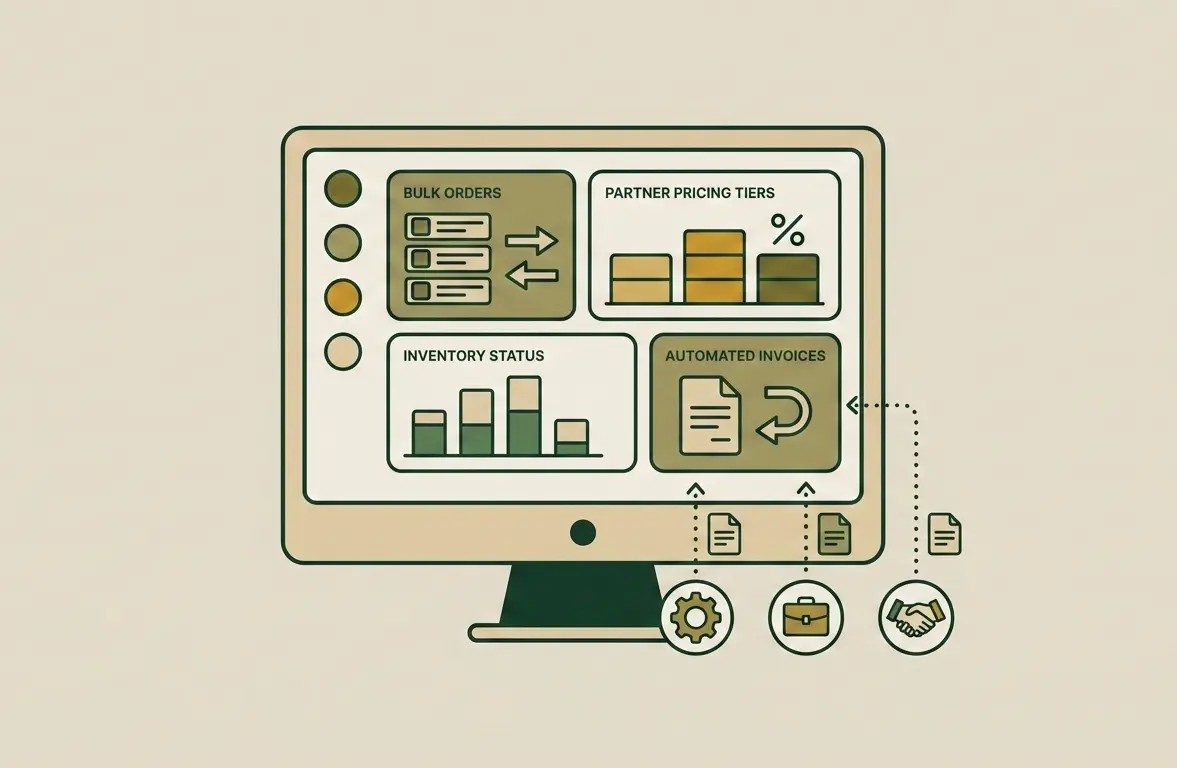
B2B e-commerce is the stage of a company’s maturity when direct business-to-business sales exceed retail in volume. If you still manage wholesale clients through email, Excel spreadsheets, and phone calls, you are not controlling your business potential. Instead, you depend on the human factor. Creating a B2B portal is not an expense for a new […]

If you don’t measure, you don’t manage. An online store owner who makes decisions based on intuition is like a driver with their eyes blindfolded. Today, Google Analytics 4 (GA4) is not just a trendy tool — it is a critically important instrument for the survival and growth of your business. We will show how […]
Building a Marketplace — Ecosystem Engineering for Market Dominance
Creating a marketplace is an architectural challenge far more complex than developing a standard online store. Success here depends on the network effect and the platform’s ability to manage complex, nonlinear relationships between sellers, buyers, and you as the arbitrator.
Your site must become more than just a place for transactions; it should be a self-sustaining economic zone. At Kliox, we design precisely such scalable ecosystems where every element, from moderation to the financial engine, works to increase your commission base.
The Trust and Quality Problem, or How to Avoid Marketplace Toxicity
A saturated market quickly becomes toxic due to unscrupulous sellers. This destroys trust in the platform and drives buyers away.
Reputation Management as a System
We don’t just implement star ratings. We build a multi-level feedback system. Buyers evaluate not only the product but also the Seller Service (packing speed, communication quality).
This secondary rating directly affects a seller’s visibility in marketplace searches. We integrate arbitration and dispute resolution mechanisms, allowing you to act as an independent arbitrator while maintaining high-quality standards.
Content Moderation at Industrial Scale
When thousands of new products appear on the platform daily, manual checks are impossible. We set up automated scripts that verify photo compliance with requirements, the presence of required certificates (uploaded by the seller), and check for duplicates.
This ensures a clean catalog and reduces the risk of complaints.
Platform Financial Engine: Transparency and Commission Automation
A successful marketplace requires flawless handling of money. Transparency of financial flows is key to building seller trust in your platform.
Monetization Models Adapted to Your Niche
We don’t limit ourselves to a standard percentage; we implement complex models: fixed transaction fees, subscriptions for premium sellers, cost-per-click (CPC), or sales commission. You choose the economic model.
Automatic Fund Distribution
A key element is integration with payment gateways that support Split Payment. This means when a buyer pays 1000 UAH, the system automatically splits the amount, sending, for example, 850 UAH to the seller and 150 UAH (your commission) to the marketplace account.
This completely eliminates the need for manual payouts and reporting.
Technology and Architecture: Ensuring Seamless System Operation
A marketplace always involves high load and the need for instant communication between different participants.
Platform and Scalability
For large projects, we don’t use out-of-the-box CMS. Instead, we choose frameworks like Laravel, allowing the creation of custom architecture. This enables horizontal scaling as your traffic and number of sellers increase tenfold.
Search and Filtering Speed
In large catalogs, speed is a competitive advantage. We integrate specialized search engines (Elasticsearch) so that searches across 10–15 criteria (category, brand, price, seller rating) happen instantly.
This is a direct factor in user retention.
Acquisition Strategy: How to Populate the Platform with Quality Sellers
Even the best platform won’t work without quality sellers. Your SEO strategy must target not only buyers but also suppliers.
B2B Acquisition Through Expertise
We help create a seller section where you showcase the benefits of working on your platform (lower commission, better analytics, higher audience loyalty). This content “sells” your marketplace to other businesses.
Working with SEO Structure
Every seller page must be indexed by Google. We provide unique SEO tags and clean URLs for thousands of pages, attracting targeted traffic searching for a specific seller or category.
Building a marketplace is about creating your own economic system. Kliox provides engineering precision, transparent financial logic, and moderation tools, enabling you to become not just a platform but a modern, reliable, and profitable marketplace ecosystem.