Many entrepreneurs perceive SEO as something complex, almost magical. In reality, successful website SEO optimization is not shamanism, but systematic engineering work.
It is like building a reliable house: if you lay the right foundation and erect the walls according to a plan, it will serve you for years, bringing a stable flow of free customers from Google.
In this detailed SEO checklist, we will step by step go through all stages of on-page optimization—from laying the technical foundation to the final “finishing” with content. You can use it to independently audit your website or to control the work of a contractor.
Section 1: Technical foundation — laying a solid base
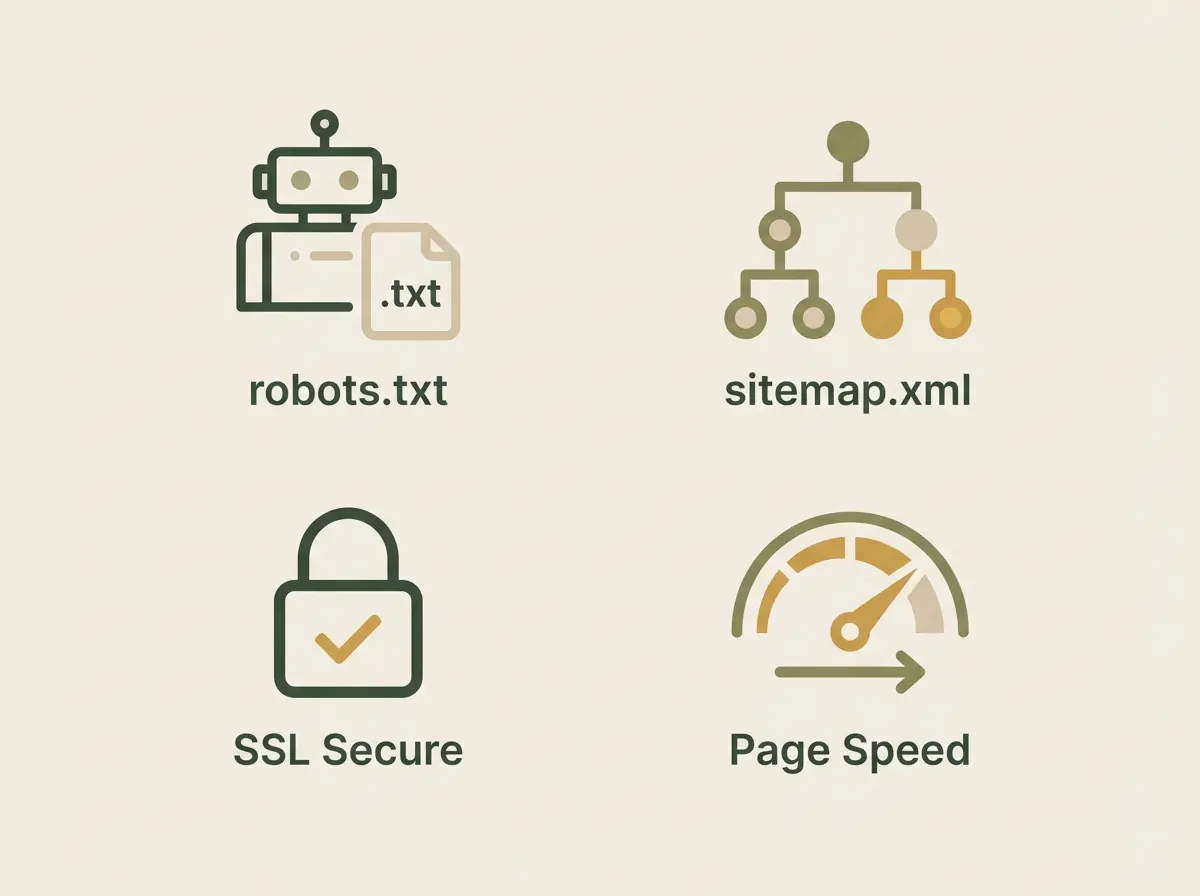
Without a strong technical foundation, any further promotion efforts will be pointless. These are the basic settings that allow Google search bots to properly see and index your website.
1. robots.txt file — instructions for bots
What is it? A simple text file that tells search bots which pages of your site can be crawled and which cannot (for example, the cart, checkout pages, internal search results).
Business impact: A properly configured robots.txt saves crawl budget (the attention Google gives to your site) by directing bots to important product and category pages.
How to check: Enter your-site.com/robots.txt in the browser. If you see a 404 error, you have a problem.
2. sitemap.xml — a guide for Google
What is it? A map of your website that contains links to all important pages you want to appear in search results.
Business impact: Sitemap.xml helps Google find and index all your products and categories faster, especially if you have a large assortment and a complex site structure. New products get into search results faster.
How to check: Enter your-site.com/sitemap.xml. Also check that this file is added to Google Search Console.
3. SSL certificate (HTTPS) — security guarantee
What is it? The same padlock next to the site address that encrypts data between the website and the user.
Business impact: First, trust. Browsers mark sites without SSL as unsafe, and customers simply will not enter their card details on them. Second, SEO. For Google, HTTPS is a mandatory ranking factor.
4. Page speed — respect for the customer
What is it? The time it takes for your website to become fully available for interaction.
Business impact: A slow website = high bounce rate, low conversion, and poor behavioral factors, which directly lowers your positions in Google. Speed is one of the most important elements of the foundation.
Section 2: Semantic core — the language of your customers
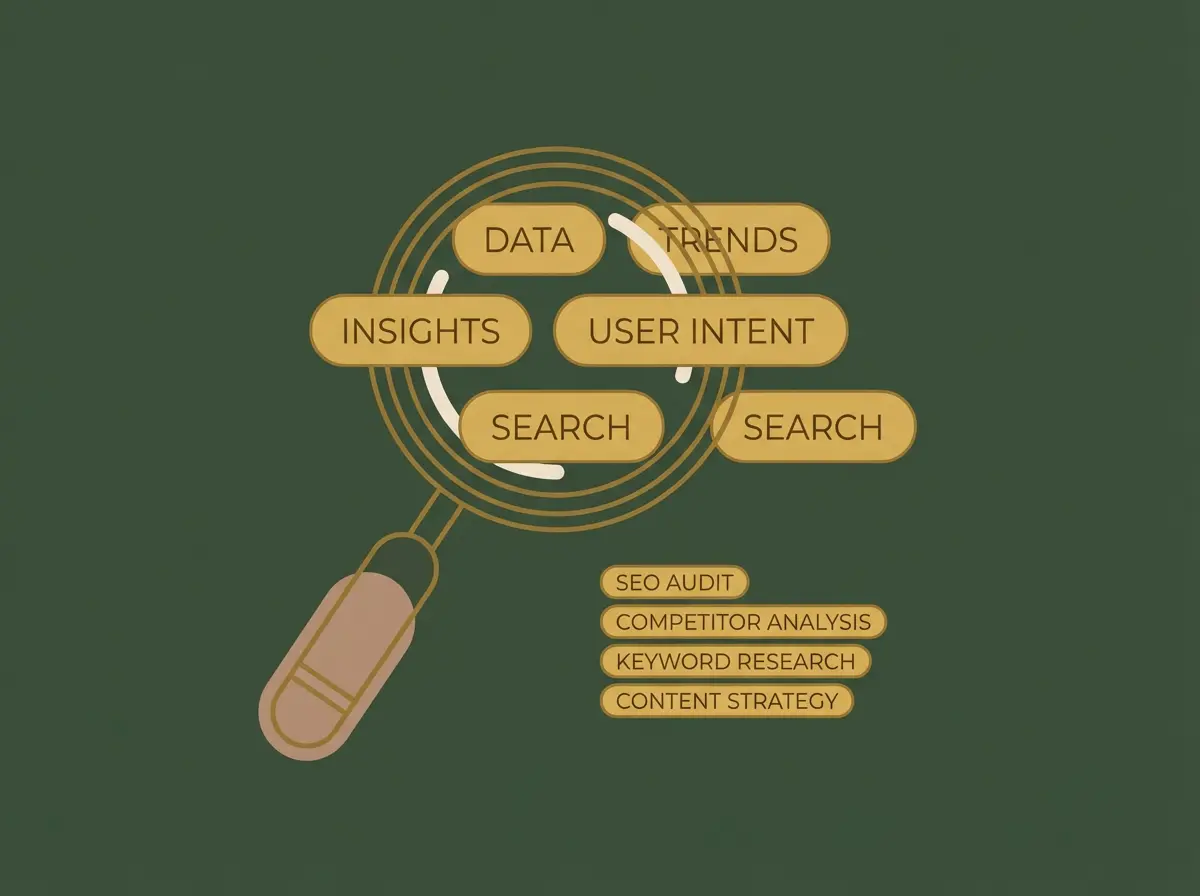
Semantic core is a complete list of words and phrases (keywords) that your potential customers use to search for your products on Google. Without this list, any website SEO optimization is shooting blind.
Business impact: Properly collected semantics allows you to attract hot traffic—people who are already ready to buy. You stop guessing and start systematically responding to real market demand.
How to properly collect keywords?
- Start with brainstorming. Write down all possible names of your products and categories.
- Use tools. Services such as Ahrefs, SEMrush, or the free Google Keyword Planner will help expand your list, find synonyms, and long-tail (long and specific) queries.
- Analyze competitors. See which queries your main competitors rank for at the top. This is often a source of non-obvious ideas.
- Cluster (group) queries. Combine keywords into logical groups. For example, queries buy women’s dress, summer dress price, fashion dresses 2024 belong to one group for the “Women’s dresses” category page.
Section 3: Site structure — perfect planning
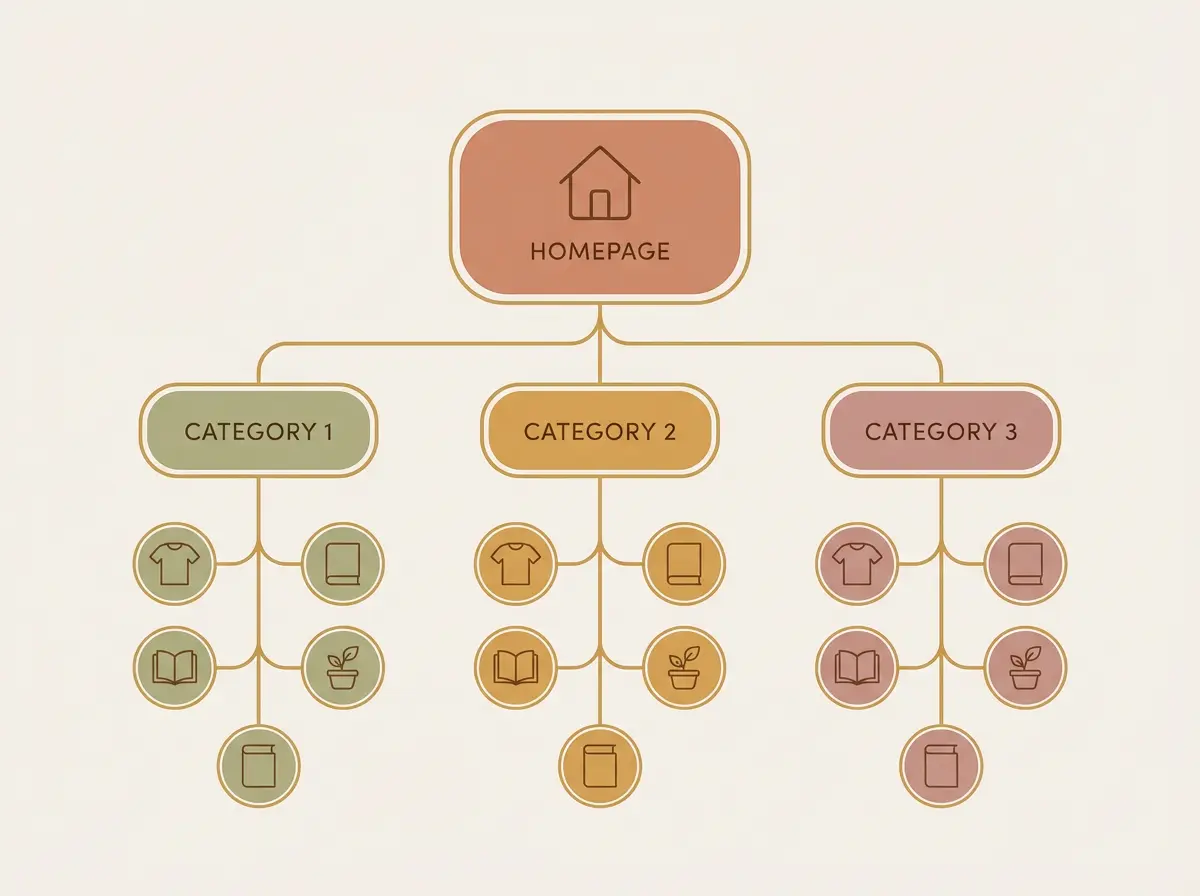
A proper site structure is a logical and intuitive arrangement of all pages that helps both users and search engines easily find the information they need.
Business impact: A well-thought-out structure improves behavioral factors (users spend more time on the site), increases page depth, and evenly distributes link equity across the site, which positively affects the promotion of all pages.
Key elements of a proper structure
Logic and hierarchy. The structure should resemble a tree: Home → Categories → Subcategories (if needed) → Product pages. A user should be able to reach any product in a maximum of 3–4 clicks.
Breadcrumbs. This is a navigation chain (e.g., Home > Shoes > Women’s sneakers) that shows the user where they are and allows them to easily return to the previous level. This is extremely important for SEO and usability.
Human-readable URLs. Page addresses should be short, clear, and contain a keyword.
Correct: /ua/shoes/running-sneakers/nike-air-max-90
Incorrect: /ua/catalog/item.php?id=58419
Section 4: Page optimization — door signs
If the site structure is the room layout, then optimizing each page is installing clear signs on the doors that tell both users and Google what is inside. The main tools for this are meta tags (Title, Description) and the H1 heading.
Business impact: Properly filled meta tags directly affect the click-through rate (CTR) of your site in search results. An attractive title and description can make a user click your link even if you are not in the first position.
Rules for optimizing key pages
Homepage:
Title: Should contain the brand name and core activity. Example: Online clothing store from a Ukrainian manufacturer | BrandName.
H1: Brand name or main slogan.
Category pages:
Title: The most important tag. Should contain the main keyword and a call to action. Example: Buy women’s sneakers in Kyiv with delivery | BrandName.
Description: An extended description highlighting benefits (wide selection, discounts, warranty).
H1: Category name. Example: Women’s sneakers.
Product pages:
Title: Should contain the product name, SKU (if searched), and the word buy. Example: Buy Nike Air Max 90 Sneakers (CZ5594-001) | BrandName.
Description: Key characteristics and benefits of the product.
H1: Full product name.
Section 5: Content — quality furniture inside
Even a perfectly built house will feel empty without quality furniture. In SEO for an online store, furniture is your content: texts, descriptions, photos, and videos.
Business impact: Unique and useful content not only helps rank for a wide range of queries, but also convinces the customer to make a purchase. This is a direct tool for increasing conversion.
Where is content king?
Product page optimization. Forget copying descriptions from the manufacturer’s website. Write unique, human-friendly text that answers customer questions and addresses their pain points. Add high-quality photos and video reviews.
Category page texts. A small SEO-optimized text (2000–3000 characters) at the bottom of a category page helps rank better for high-frequency queries and provides useful information to buyers (for example, how to choose a product from this category).
Blog. Maintaining a blog allows you to attract traffic for informational queries (e.g., how to care for leather shoes), introduce the audience to your brand, and turn cold visitors into warm leads.
Ready-made SEO checklist for your online store
We have covered the key stages of on-page optimization from the technical foundation to content. To make it easier for you to use this information in practice and control your contractors, we have prepared a concise PDF document.
It contains all the points from our article in the format of a convenient one-page SEO checklist. Print it out and check how ready your website is to conquer the top of Google.
Download the free SEO checklist
Why is it better to trust this to us?
Website SEO optimization is not a one-time action, but a continuous process. Search algorithms change, competitors stay alert, and your assortment is constantly updated. Implementing all items from this checklist on your own requires a huge amount of time and deep technical expertise.
The Kliox team handles SEO for online stores systematically. We do not just push websites to the top. We build a long-term organic traffic acquisition strategy that becomes a stable and predictable source of profit for your business. We take care of all the routine work—from technical audits to content creation—allowing you to focus on business growth.
Conclusions: a proper SEO foundation is the key to success
Properly configured on-page optimization accounts for 80% of SEO success. This is the foundation on which all your future growth will rest. By ignoring even one item from this checklist, you risk building a house on sand that will collapse at the first storm (a change in Google algorithms).
Want to get a professional technical audit of your website?
Order a free SEO audit of your online store. Our specialist will conduct a detailed analysis of your website based on the key points from this checklist, identify critical issues that hinder growth, and provide specific recommendations for fixing them.