
Most failed website development projects collapse even before the first line of code is written. The reason is simple — the absence of a clear and well-thought-out technical specification for the website. Without it, you risk getting something completely different from what you expected, missing deadlines, and exceeding the budget several times over.
Many entrepreneurs are intimidated by this stage, thinking: “I don’t know how to write a technical specification.” In reality, it’s not that difficult. In this article, we will break down the key sections, provide an example of a technical specification for an online store, and show how to turn your idea into a clear action plan for developers.
Main sections of an ideal technical specification: from idea to clear plan
A good technical specification for the website is not just a wishlist, but a detailed roadmap for your project. It should provide clear answers to key questions. Here are the main sections you should include. 
- Business goals and objectives
This is the most important section. Before talking about buttons and colors, answer the question: “Why do you need this website?”
- Clearly define the goal: increase online sales by 30%, automate order processing, enter a new market.
- Describe how you will measure success: by number of orders, average check, conversion rate.
- Description of target audience
Who is your ideal customer? A detailed target audience description will help the designer create the right visuals and the marketer set up effective advertising.
- Demographics: age, gender, location.
- Interests and behavior: What is your customer interested in, and what problems do they want to solve with your product?
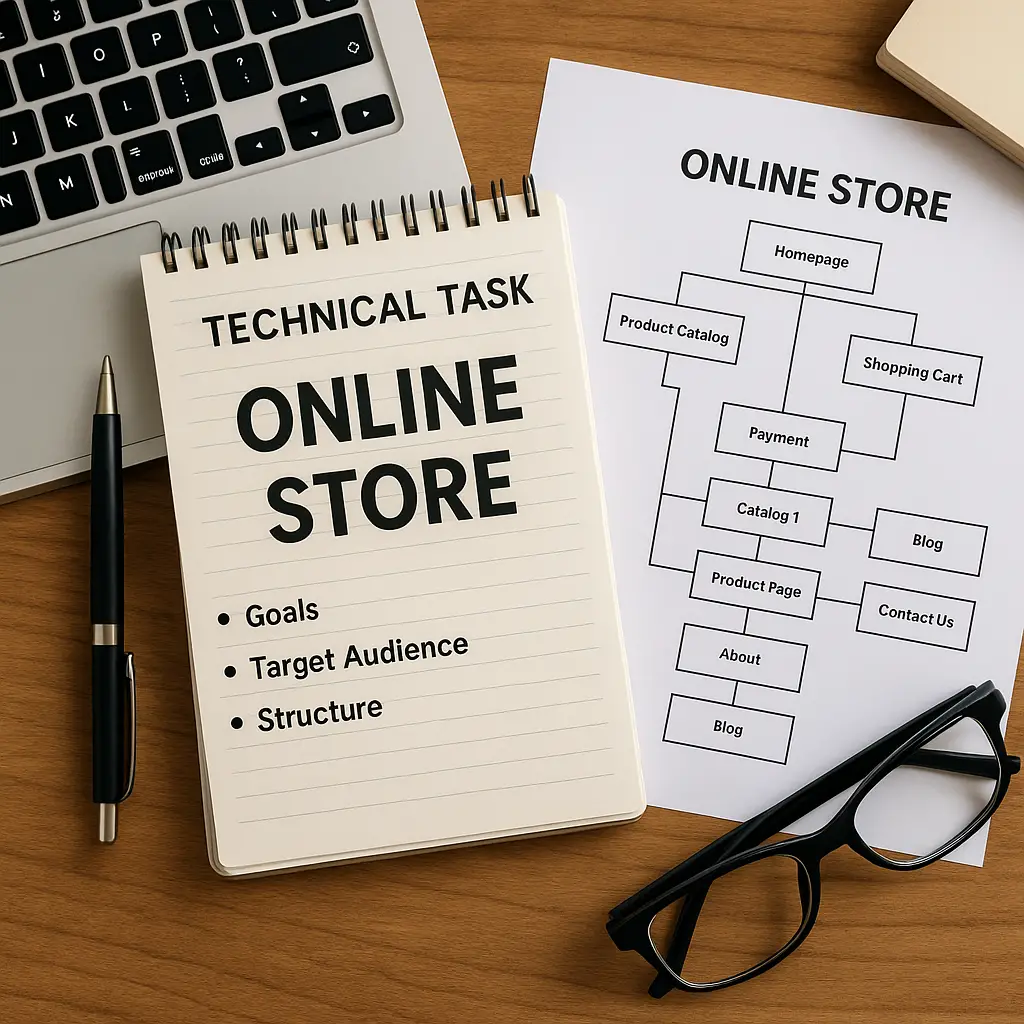
- Website structure and key pages
This is the skeleton of your future store. A well-thought-out website structure ensures easy navigation and good SEO.
- List main sections: Home, Catalog, About Us, Delivery & Payment, Contacts, Blog.
- Plan the catalog hierarchy: How will your products be grouped, what will be the categories and subcategories?
- Functional requirements
Here you need to describe in detail how your website should work. The more detailed your functional requirements, the fewer misunderstandings with developers there will be.
- Cart and checkout: is registration required, which fields need to be filled?
- Filters and sorting: by which parameters can customers search for products?
- Payment and delivery systems: which services need to be integrated?
- Personal account: what information should be stored there?
- Design requirements
Although design is a creative process, it can and should be structured.
- References: Provide 2–3 examples of websites you like (and explain why).
- Anti-references: Show websites you absolutely dislike.
- Brand identity: If you have a logo, brand colors, and fonts, be sure to include them.
Ready checklist: review your technical specification
To ensure nothing is forgotten, you can use this short checklist. Before sending the website development brief or the final technical specification, check if you answered all key questions. 
Main points of the technical specification:
- Business goals: Clearly defined main purpose of the website.
- Target audience: Detailed description of your ideal client.
- Competitor analysis: Analysis of 3–5 main competitors conducted.
- Website structure: Planned hierarchy of pages and catalog.
- Functional requirements: Detailed description of all necessary functionality.
- Design requirements: References and brand elements provided.
- Content: Clear understanding of who and how will populate the site.
Do you need to write the technical specification yourself?
Many entrepreneurs are intimidated by the prospect of preparing such a detailed document themselves. This is completely normal. You are an expert in your business, not in website design.
We at Kliox believe that creating a technical specification for the website is a collaborative effort. You don’t need to come to us with a ready 50-page document. Your idea and understanding of business goals are enough.
Our analysis and design stage is structured to assist you. We ask the right questions, conduct competitor analysis, organize your requirements, and together with you turn them into a clear and understandable action plan. We help create a prototype so you can visually see the future structure before the design begins.
Conclusion:
Thus, a detailed technical specification for the website is not unnecessary bureaucracy, but your main tool for controlling the project. It protects you from misunderstandings, missed deadlines, and unforeseen costs. The better you plan at the start, the more predictable and successful the final result will be. 
Remember, the main goal of the technical specification is to synchronize your vision with the developers’ vision. This approach allows you to create a technical specification that becomes the foundation for building a truly profitable online store.
Let’s turn your idea into a clear plan
If you feel you need help structuring your thoughts and requirements, we are ready to assist.
Tell us about your idea, and we will guide you from the first thoughts to creating a detailed technical specification for your future project.